

As businesses continue to adapt to a more connected and remote-first world, finding the right talent is no longer limited by geography. Companies today have access to skilled professionals across the globe, making remote staffing an increasingly attractive option for growth. However, when considering remote hiring strategies, many business leaders face an important question: should they choose offshore staffing or nearshore staffing?
Both staffing models offer opportunities to reduce costs, access specialized talent, and improve operational flexibility. Yet each comes with its own advantages and challenges. Understanding the differences can help you make a decision that aligns with your business goals, communication needs, and budget.
Offshore staffing involves hiring professionals in countries that are located farther away from your business. Companies often choose offshore teams because they provide access to highly qualified talent while significantly reducing labor costs. This approach has become popular among businesses looking to expand their capabilities without increasing overhead expenses. Whether it’s customer support, medical billing, legal services, accounting, data processing, or administrative support, offshore staffing allows organizations to build dedicated teams that operate as an extension of their business.
One of the biggest reasons companies choose offshore staffing is affordability. Hiring remote professionals from offshore locations can often cost far less than hiring locally, allowing businesses to allocate resources toward growth, innovation, and customer service. In addition to cost savings, offshore staffing provides access to a broad talent pool with diverse skills and experience. Businesses are no longer restricted by local hiring shortages and can find professionals who match their exact requirements.
Another advantage is scalability. As business needs change, offshore teams can often be expanded or adjusted more quickly than traditional in-house teams. This flexibility is particularly valuable for growing companies that need to adapt to changing workloads and market demands.
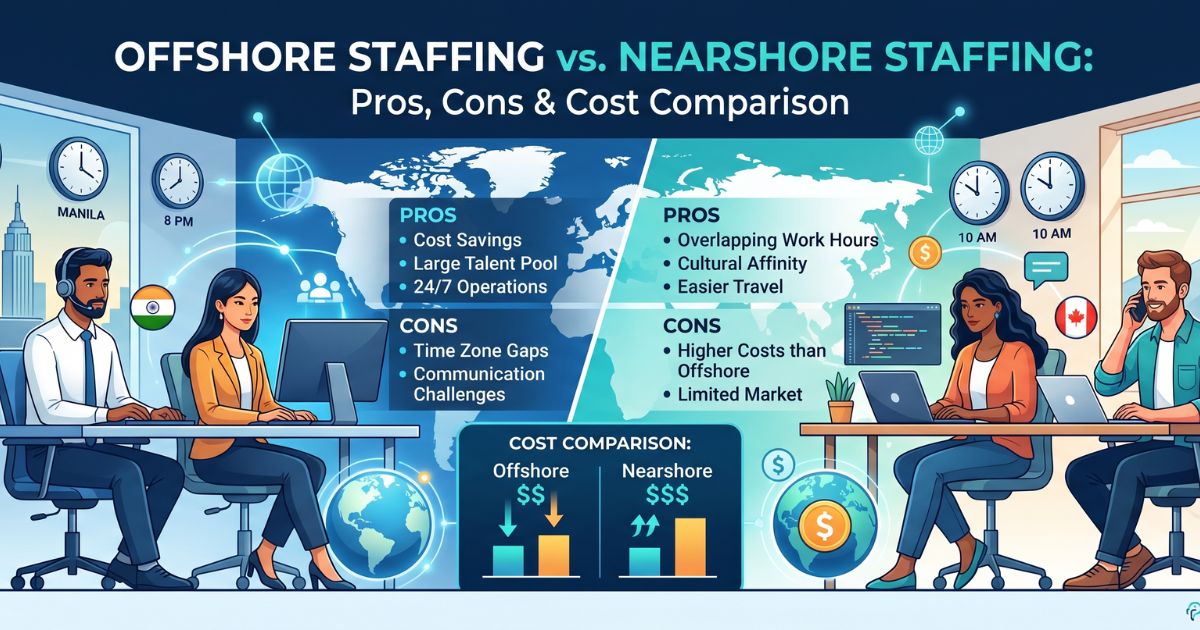
Of course, offshore staffing is not without challenges. Time zone differences can sometimes make communication more complex, especially for organizations that require frequent real-time collaboration. Cultural differences may also influence communication styles and work habits. However, with clear processes, effective management, and modern collaboration tools, these challenges can usually be addressed successfully.
Nearshore staffing takes a slightly different approach. Instead of hiring talent from distant countries, businesses recruit professionals from neighboring regions that share similar time zones. The primary benefit of this model is easier communication. Since working hours often overlap, teams can collaborate in real time, hold meetings more conveniently, and respond quickly to urgent needs.
For businesses that rely heavily on daily interaction, nearshore staffing can provide a smoother working experience. Similar cultural backgrounds and business practices may also make onboarding and team integration easier. This can help create stronger collaboration and reduce misunderstandings that occasionally occur in global teams.
While nearshore staffing offers these communication advantages, it typically comes at a higher cost than offshore staffing. Labor rates in nearshore locations are often more expensive, reducing some of the financial benefits that businesses seek through remote hiring. Additionally, the available talent pool may be smaller, making it more difficult to find highly specialized professionals for certain roles.
When comparing costs, offshore staffing generally provides the greatest savings. Businesses can often reduce staffing expenses substantially while still maintaining high levels of productivity and quality. Nearshore staffing remains more affordable than traditional local hiring in many cases, but the savings are usually less significant due to higher wages and stronger competition for talent.
The right choice ultimately depends on your priorities. If reducing costs and accessing a wide range of skilled professionals are your primary objectives, offshore staffing may be the better option. Companies looking for flexibility, scalability, and long-term workforce solutions often find offshore teams to be an effective way to support growth. On the other hand, businesses that require constant collaboration during the same working hours may prefer the convenience and accessibility offered by nearshore staffing.
Advances in technology have also made the decision easier than ever before. Video conferencing, cloud-based project management tools, secure communication platforms, and workflow automation systems have transformed how remote teams work together. Today, businesses can successfully manage teams across different countries while maintaining strong communication and accountability.
At KHP RemoteFTE, we help businesses build dedicated remote teams tailored to their unique needs. Our approach goes beyond traditional outsourcing by providing professionals who work exclusively for your organization. This allows businesses to maintain control, consistency, and quality while benefiting from the flexibility and cost advantages of remote staffing.
Whether you need support for medical billing, legal services, customer support, administration, accounting, or other back-office functions, our dedicated staffing solutions are designed to help you grow efficiently and confidently.
In the end, both offshore staffing and nearshore staffing can deliver excellent results when implemented correctly. The key is understanding what matters most to your organization. If your focus is maximum cost efficiency, access to global talent, and scalability, offshore staffing is often the preferred choice. If real-time collaboration and geographic proximity are top priorities, nearshore staffing may be a better fit. By evaluating your business needs carefully and partnering with the right staffing provider, you can build a remote team that supports long-term success and sustainable growth.